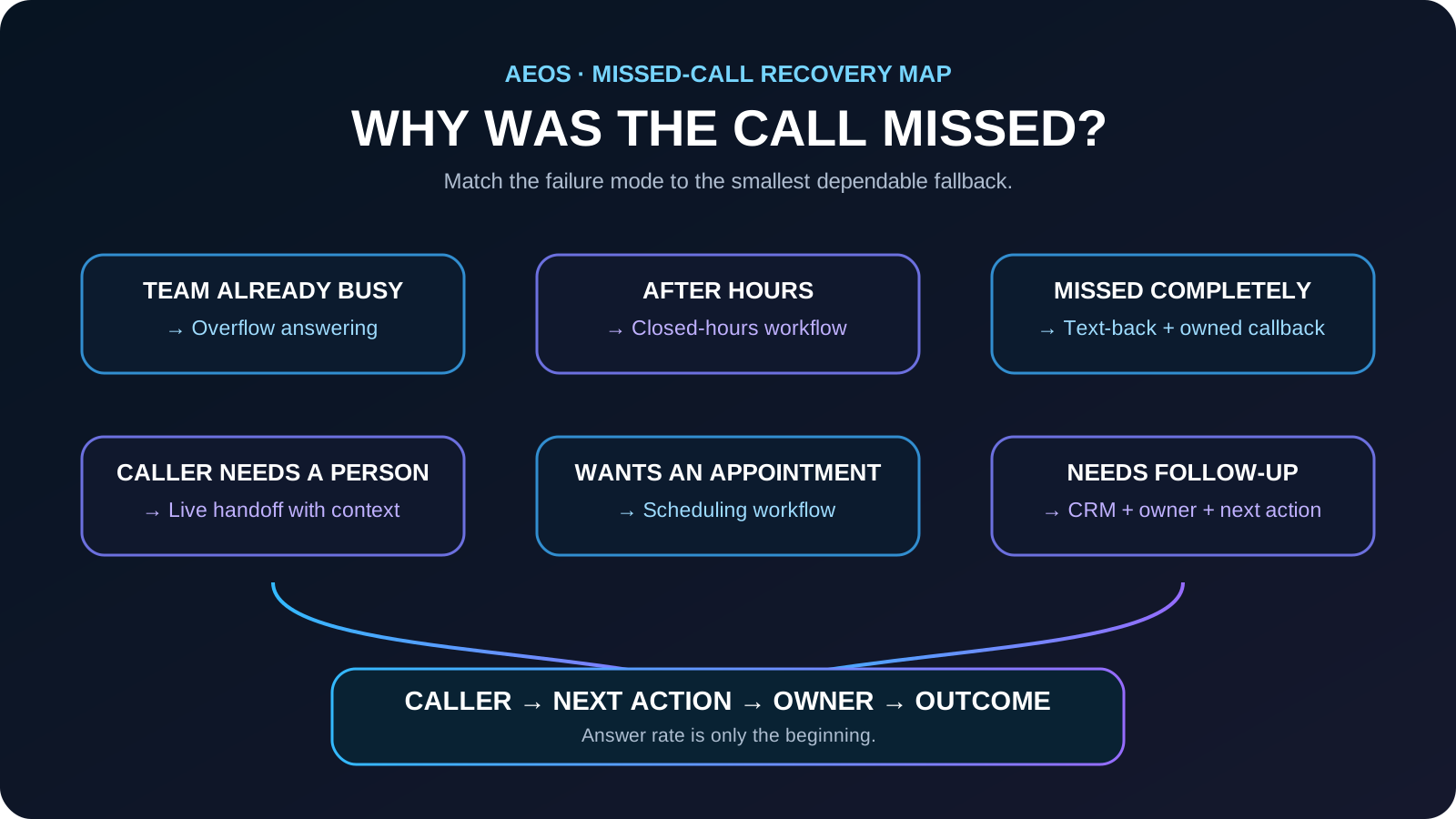
How can a small business stop missing customer calls?
A small business can stop missing customer calls by matching each failure mode to a dependable fallback. If the team is already on another call, use overflow. If the office is closed, use a separate after-hours path. If no voice path connects, use missed-call text-back and an owned callback queue. If the caller needs a person, transfer or hand off with context. If the caller wants an appointment, move the request into scheduling. The goal is not merely to answer more rings; it is to give every valuable caller a clear next action, owner, and recorded outcome.
What matters most
- Diagnose why the call was missed before choosing the fix.
- Give the team the first chance to answer, but define exactly where busy, unanswered, simultaneous, and after-hours calls go next.
- Use overflow for capacity gaps, after-hours rules for closed periods, and text-back plus owned follow-up when voice still fails.
- Choose team members or human answering for sensitive and judgment-heavy calls; use AI for approved repetitive and structured work.
- Measure the full call-to-outcome chain so an answered or recovered call cannot disappear without a next action.
- Use the smallest system that reliably fixes the real coverage gap instead of automating every call by default.
How to Stop Missing Customer Calls: 9 Practical Solutions for Small Businesses (2026)
Small businesses usually miss calls because the team is already doing real work: helping a customer, driving, using tools, handling another call, working after normal hours, or covering more demand than one phone path can absorb.
The fastest way to improve the system is to identify why each call is being missed and give that failure mode a specific fallback. The fallback may be another team member, overflow answering, an after-hours workflow, missed-call text-back, a human answering service, an AI receptionist, or a hybrid of those options.
A call is not fully recovered just because somebody or something answered it. The caller still needs a clear next action, an owner, and an outcome the business can see.
Start here: match the missed call to the right fix
Before buying a new phone system or answering service, identify the exact moment calls are being lost. Different failure modes need different fixes.
- Already on another call → add overflow answering or a second approved answering path.
- Working with an in-person customer → let the team stay focused while overflow or AI backup captures the new caller.
- After hours → use a dedicated closed-hours path with accurate availability, intake, scheduling, and approved escalation.
- The call was missed completely → send missed-call text-back and create an owned callback or follow-up task.
- The caller asks for a person → transfer or hand off to a team member with the caller’s context attached.
- The caller wants an appointment → move the request into the scheduling workflow instead of leaving it in voicemail.
- The caller needs continued follow-up → create a CRM record, next action, owner, and status so the request cannot disappear.
Diagnose the missed-call reason first. Then add the smallest fallback that reliably moves the caller to a useful next step.
Why businesses miss calls in the first place
Most missed calls are capacity problems, not motivation problems. The phone competes with the work already in progress, and a single line or single person cannot absorb every peak.
- The owner or technician is driving, working with tools, or already with a customer.
- The front desk is helping an in-person customer or handling another call.
- Two or more callers arrive at the same time.
- Calls arrive during lunch, evenings, weekends, holidays, or other uncovered periods.
- Staff assume somebody else will answer or call back.
- Spam and low-value calls make the team slower to pick up unknown numbers.
- Voicemail records a message but does not assign a next action or deadline.
Treat a missed call as a workflow failure: the first answering path was unavailable and no dependable second path took ownership.
1. Use conditional call forwarding before calls die in voicemail
Conditional call forwarding sends a call somewhere else only when the primary line is busy or unanswered. It is often the simplest way to give employees the first chance to answer while still creating a fallback.
The destination can be another employee, an overflow phone, a live answering service, or an AI receptionist. Carrier and phone-system settings vary, so the forwarding rule should be verified with a real inbound call before it is treated as live.
- Keep the existing business number as the number customers call.
- Forward only the conditions you actually want covered, such as unanswered, busy, or after-hours calls.
- Verify that caller ID or the caller's number reaches the fallback system as expected.
- Test what happens when the fallback cannot complete the call.
2. Use a ring group so one person is not the whole phone system
If several people can legitimately answer the same type of call, ring more than one approved person or device. A ring group reduces the chance that a customer reaches voicemail simply because the designated phone is in the wrong hands at that moment.
Ring groups work best when ownership is explicit. Everyone should know who can answer, what they are allowed to promise, and where unresolved calls go next.
- Use a small, relevant answering group instead of ringing everyone.
- Separate sales, service, billing, and urgent calls when their handling rules differ.
- Give the group a defined overflow path rather than letting an unanswered group ring indefinitely.
3. Add overflow answering for busy periods and simultaneous calls
Overflow coverage handles the calls your primary team could not take. It is especially useful when the business normally answers well but loses calls during bursts, lunch coverage, job-site work, or simultaneous conversations.
Overflow is different from replacing the front desk. Humans can remain first in line while the fallback layer answers only when the normal operation is occupied.
- Define how long the primary team gets the first opportunity to answer.
- Send overflow calls to a destination that can capture the reason for the call, not just another generic voicemail.
- Create separate transfer rules for urgent and routine requests.
- Log whether the overflow call ended in a transfer, booking, lead, callback, or unresolved request.
4. Build an after-hours call path instead of using daytime rules all night
After-hours callers usually need a different experience from daytime callers. Some only need hours, location, or a booking request. Others may have an urgent service problem that deserves escalation.
Define closed-hours behavior separately so the system knows what can wait, what can be scheduled, and what should reach an on-call person.
- State the business's current availability accurately.
- Capture the caller's reason, contact information, location, and urgency when relevant.
- Offer a booking or callback path for routine requests.
- Escalate only the categories the business has explicitly approved for after-hours transfer.
5. Use missed-call text-back to keep the conversation alive
When a call still goes unanswered, an immediate text can turn a dead phone event into an active conversation. The message should acknowledge the missed call, identify the business, and offer one simple next step.
Text-back is useful as a recovery layer, but it is not a complete answer for every caller. Landlines may not receive texts, some callers need immediate voice help, and urgent situations may require a transfer instead.
- Ask what the caller needs instead of sending a generic marketing message.
- Do not promise a callback time the business cannot meet.
- Connect the reply to a real owner or queue so the conversation is not abandoned a second time.
6. Make voicemail the last fallback, not the whole strategy
Voicemail can still be useful for low-volume or low-urgency businesses, but it should be treated as the final fallback after better answering paths have been exhausted.
A useful voicemail tells the caller what information to leave, what will happen next, and what to do if the matter cannot wait. The business should also have a defined process for reviewing and closing those messages.
- Ask for the caller's name, callback number, and reason for calling.
- Give a realistic response window rather than a vague promise.
- Assign voicemail review to a named role or queue.
- Measure how many voicemail callers are actually reached and resolved.
7. Use a human answering service when judgment and empathy matter most
A human answering service can be the right choice when calls are sensitive, emotionally complex, highly variable, or likely to require judgment that should not be automated.
The quality of a human service depends on the instructions, training, escalation rules, and information available to the receptionist. A human answer is only useful if the handoff to the business is accurate and timely.
- Good fit: complaints, sensitive situations, complex intake, high-value conversations, and callers who strongly prefer a person.
- Check how the service handles transfers, after-hours escalation, message accuracy, and busy-period capacity.
- Measure completed handoffs instead of assuming every answered call was successfully handled.
8. Use an AI receptionist for repetitive, structured call work
An AI receptionist is useful when many calls follow repeatable patterns: hours, service area, basic qualification, appointment requests, estimate requests, directions, common questions, structured intake, and routing.
The system should have explicit boundaries. It should know what information it may provide, what it must capture, when it may transfer a caller, and when it should stop and hand the situation to a person.
The advantage is not simply that software can answer. The advantage is that the same intake and routing rules can be applied consistently when the normal team is busy or unavailable.
- Define approved business knowledge and prohibited promises.
- Capture structured fields that the team actually needs for the next action.
- Create transfer triggers for urgent or human-requested calls.
- Keep a human path for situations the automated flow should not decide.
9. Combine humans and AI instead of forcing an all-or-nothing choice
For many small businesses, the strongest design is hybrid: employees answer when they are available, while automation covers overflow, simultaneous calls, repetitive questions, and after-hours intake. A human can remain the preferred path without making voicemail the only backup.
This structure also makes adoption easier because the business can automate the predictable parts first and keep sensitive or high-judgment conversations with people.
- Humans first for calls that benefit from relationship, judgment, or empathy.
- Automation for overflow, structured intake, repetitive questions, and routine scheduling requests.
- Explicit escalation when the caller asks for a person or the situation exceeds the automated rules.
- One shared definition of what counts as resolved, pending, transferred, or requiring follow-up.
Which missed-call solution is right for your business?
Choose the smallest system that reliably closes the gap you actually have. A low-volume office with predictable coverage does not need the same setup as a field-service company receiving simultaneous calls at night.
- Very low call volume and low urgency: clear voicemail plus disciplined callbacks may be enough.
- Calls missed because one employee is temporarily busy: conditional forwarding or a ring group.
- Calls missed during peaks or simultaneous demand: overflow answering.
- Calls missed mainly at night or on weekends: dedicated after-hours rules.
- Callers often abandon voice but can continue by message: missed-call text-back as a recovery layer.
- Sensitive, ambiguous, or judgment-heavy conversations: human answering service or internal staff.
- High repetitive volume with structured questions and intake: AI receptionist.
- Existing human team that still has gaps: hybrid human-first plus AI overflow and after-hours coverage.
The best answer is not the most automated option. It is the least complicated setup that gives each valuable caller a dependable next step.
Measure the whole call-to-outcome chain
Answer rate alone can hide failures. A call can be answered and still be lost if the caller's need is misunderstood, no next action is created, or nobody owns the follow-up.
A practical operating model is: offered call → primary answer or overflow → intent captured → next action created → owner assigned → deadline or status set → outcome recorded. This is the call-to-outcome chain AEOS uses as the useful unit of work.
Review the broken state in that chain, not just the total number of missed rings. That tells you whether the next improvement belongs in routing, answering, qualification, transfer, scheduling, or follow-up.
- Calls offered and calls answered
- Calls that reached overflow or after-hours coverage
- Calls with complete contact and intent records
- Time to the first meaningful response
- Transfers, bookings, estimates, or callback tasks created
- Calls still unresolved after the promised response window
- Repeat callers who had to explain the same request again
Where AEOS fits
AEOS is designed as an operating layer behind the business's existing customer-call workflow. The practical use is not to force every caller through automation. It is to give the business another controlled path when the primary team cannot answer.
A configured workflow can use structured intake, routing, transfer rules, scheduling actions, CRM records, and follow-up ownership so the call moves toward a business outcome instead of ending as an isolated phone event.
The operating goal is simple: humans keep control of the business, while the system makes sure an unanswered ring does not automatically become an abandoned opportunity.
Example: a mobile service owner is already working with a customer
A new customer calls for help while the owner is under a vehicle and cannot safely stop to answer the phone.
The primary phone gets the first opportunity to ring. If it is unanswered, the approved overflow path captures the caller’s name, vehicle, problem, location, urgency, and preferred callback details, then creates the appropriate transfer, scheduling, CRM, or follow-up action.
The owner can finish the current job safely while the new caller receives a clear next step and the business receives a structured request with an owner instead of an unexplained missed-call notification.
Frequently asked questions
What is the fastest way to stop missing business calls?
Start by identifying when calls are missed, then add a dependable fallback such as conditional forwarding or overflow answering. The fastest useful fix is the one that sends an unanswered call to a real next step instead of leaving it to an unowned voicemail.
What is the difference between call forwarding and overflow answering?
Call forwarding is the routing rule that sends a call to another destination. Overflow answering is the operating role of that destination when the primary team cannot answer. Forwarding can send the call to another employee, a human service, an AI receptionist, or another approved fallback.
Is voicemail enough for a small business?
It can be enough when call volume and urgency are low and callbacks are handled reliably. If valuable callers frequently need an immediate answer, qualification, scheduling, or escalation, voicemail is better used as the final fallback rather than the primary call strategy.
Should a small business use a human answering service or an AI receptionist?
Use humans when calls are sensitive, ambiguous, relationship-heavy, or require judgment. AI is better suited to repetitive questions, structured intake, routine scheduling requests, and overflow. Many businesses can use a hybrid model so humans remain first while AI covers predictable gaps.
Can an AI receptionist transfer urgent calls to a person?
It can when the system and business rules are configured to allow transfers. The business should define which situations qualify, who may receive the transfer, what happens when that person is unavailable, and which situations should never be decided automatically.
How do I know whether my missed-call system is working?
Track more than answer rate. Measure complete caller records, time to meaningful response, transfers or bookings created, callback ownership, unresolved requests, and repeat callers. The system is improving when fewer valuable calls end without a clear next action and owner.
What should happen immediately after a business misses a customer call?
The caller should enter a defined recovery path instead of an unowned voicemail. Depending on the business, that can mean overflow answering, a missed-call text-back, a structured callback task, scheduling, or escalation to a team member. The important part is that the next action and owner are clear.
What is the best fallback when my team is already on another call?
Use an overflow path that activates only when the primary team cannot answer. The destination can be another approved team member, a human answering service, an AI receptionist, or another system that can capture the caller’s intent and create the correct next action.
How to verify this answer in your own business
The recommendations on this page can be tested directly against the business’s own call records: why calls were missed, which fallback answered, whether intent was captured, what next action was created, who owned it, and whether the request reached an outcome.
- calls offered
- calls answered by the primary team
- overflow and after-hours calls
- complete caller-intent records
- time to meaningful response
- transfers and bookings created
- callback tasks completed
- unresolved call requests
Compare call dispositions before and after each change. Review missed, overflow, after-hours, transferred, booked, text-recovered, and unresolved calls. Identify the exact stage where callers still fail to reach a useful next action, then change only that stage.
Evidence policy: this page does not invent a universal conversion rate. Results depend on call demand, workflow quality, staff response, and implementation.
See how AEOS connects customer conversations to business actions.
Explore AEOS by Orca Charts for AI receptionist, scheduling, CRM, follow-up, business Q&A, live transfers, and team workflows for Missed-Call Cost & Pain.