AI receptionist vs hiring a receptionist: which is better for cost, coverage, and a hybrid team?
Hire a team member when the role depends on physical presence, complex judgment, relationship-heavy service, broad office ownership, or unusual situations. Use an AI receptionist for approved repeatable phone workflows such as answering common questions, capturing leads, structured appointment requests, overflow, and after-hours coverage. For many small businesses, the strongest model is hybrid: keep the team member responsible for judgment and relationships while AEOS handles defined coverage gaps, routine execution, and structured handoffs.
What matters most
- Compare the actual work, not the labels “employee” and “AI.”
- A standard 40-hour staffed schedule leaves 128 hours in a 168-hour week outside that schedule.
- Use team members for judgment, relationships, exceptions, physical presence, and broad office ownership.
- Use AEOS for approved repeatable calls, structured intake, overflow, after-hours coverage, scheduling, and follow-up.
- A hybrid model can keep the team member primary while AI removes repetitive interruption and coverage gaps.
- Compare total operating cost, coverage, completed outcomes, and handoff quality rather than salary versus software price alone.
AI Receptionist vs Hiring a Receptionist: Cost, Coverage & Hybrid Model (2026)
An AI receptionist and a team member should not be treated as interchangeable workers. A person is strongest at judgment, relationships, unusual situations, physical front-desk work, and broad administrative ownership. AEOS is strongest at approved repeatable workflows: answering routine questions, capturing intent, scheduling, overflow, after-hours coverage, follow-up, and returning structured context to the team.
The better comparison is not person versus AI. It is which work belongs to a person, which work can be executed reliably by AI, and what happens during the hours and moments when the team member is unavailable or already helping someone else.
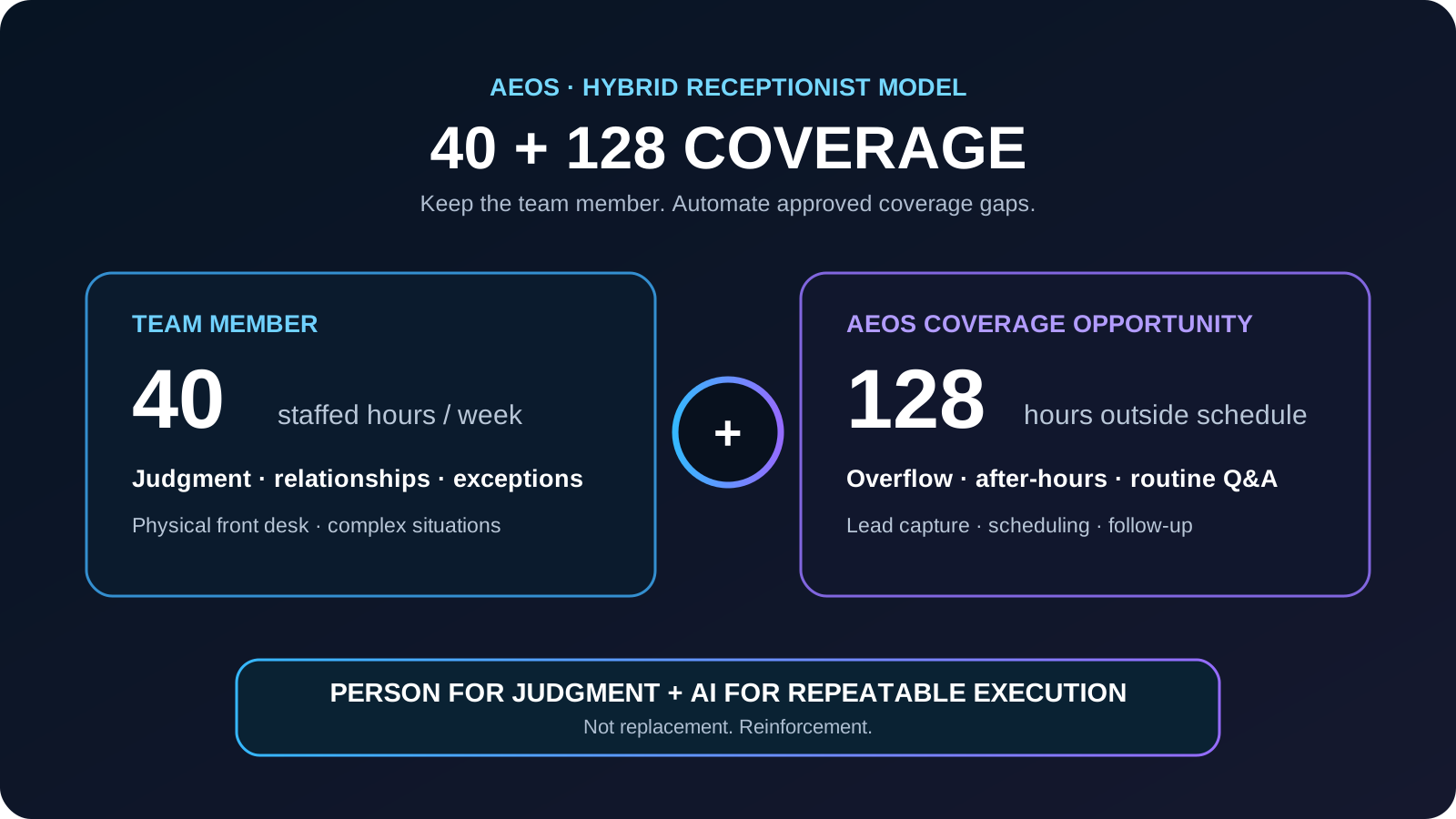
The 40 + 128 coverage model
A week contains 168 hours. If a receptionist or team member is scheduled for 40 hours, 128 hours remain outside that staffed schedule. That gap includes evenings, overnight, weekends, lunch coverage, busy periods, and moments when the team member is already helping someone else.
The decision is not simply whether AI costs less than a person. The more useful question is whether the business wants a person to own judgment-heavy work while AEOS covers approved repeatable workflows when the team is unavailable or overloaded.
- 40 staffed hours: relationship building, judgment, exceptions, physical front-desk work, and complex customer situations.
- 128 hours outside a 40-hour schedule: after-hours coverage opportunities, overflow, routine questions, lead capture, and structured appointment requests.
- Hybrid model: the team member stays primary while AEOS handles defined gaps and passes structured context back to the team.
The opportunity is not to replace the team member. It is to decide what covers the other 128 hours.
What AEOS can take off the team’s plate
AEOS is designed to connect a customer conversation to the next business action instead of acting like a standalone answering machine. The business chooses which workflows AI may handle and where a team member should take over.
- Automatic scheduling: turn AI coverage on and off around business hours and approved schedules.
- Synced voice, text, and web controls: operational changes stay aligned across control surfaces.
- Automatic lead follow-up by text: captured leads can receive configured follow-up instead of waiting in voicemail.
- Appointment scheduling: structured requests can move into the scheduling workflow.
- AI email drafting: prepare customer follow-up drafts from captured context.
- Custom CRM: keep customer details, call history, follow-up, and outcomes together.
- Business Q&A: answer approved questions about services, hours, policies, and coverage.
- Live transfers: hand the caller to a team member when a person is needed.
The hybrid advantage is continuity: AI handles repeatable execution while team members keep ownership of judgment and relationships.
Short answer: hire for presence and judgment; use AI for structured phone work
Hire a human receptionist when the role depends on being physically present, handling unpredictable customer situations, coordinating people and paperwork, or exercising discretion that cannot be reduced to an approved workflow.
Use an AI receptionist when the main problem is missed calls, repetitive questions, structured qualification, appointment requests, overflow, simultaneous demand, or after-hours phone coverage. Use a hybrid when the business needs human judgment but does not want every routine call to interrupt that person.
The decision is not 'human or AI forever.' It is 'which work should a person own, which work can a system handle, and where must the handoff occur?'
Human receptionist vs AI receptionist: side-by-side comparison
| Decision factor | Human receptionist | AI receptionist |
|---|---|---|
| Phone answering | Yes, during staffed coverage | Yes, during configured coverage |
| Nights, weekends, and overflow | Requires staffing or an additional answering layer | Can cover approved hours and overflow when configured |
| Appointment and estimate requests | Can handle them with training and system access | Can handle structured requests within configured rules |
| Lead capture | Flexible and conversational | Consistent required-field capture |
| Physical front desk | Yes | No |
| Complex or emotional situations | Strong fit for judgment, empathy, and exceptions | Should escalate when the situation exceeds approved rules |
| Simultaneous routine calls | Limited by available staff | Can handle multiple configured conversations subject to system capacity |
| Training and management | Hiring, onboarding, coaching, scheduling, and retention | Configuration, testing, monitoring, and workflow revision |
| Consistency | Varies with workload, training, and individual performance | Applies the configured workflow consistently |
| Failure mode | Unavailable staff, human error, or incomplete handoff | Bad configuration, integration failure, or an unhandled edge case |
When you should hire a human receptionist
A human receptionist is the better choice when the job is broader than answering predictable calls. If the person is expected to manage a lobby, recognize returning customers, handle sensitive complaints, coordinate internal priorities, work with physical documents, or resolve situations that were never anticipated in a script, the role depends on human presence and judgment.
- Customers regularly arrive in person and need someone at a physical front desk.
- Calls are often emotional, sensitive, ambiguous, or relationship-heavy.
- The receptionist coordinates staff, vendors, paperwork, mail, or other office operations.
- The business wants one person to notice context and take ownership across departments.
- Exceptions are common enough that scripted escalation would create more work than it removes.
- The receptionist role is also an administrative or customer-success position.
If the business genuinely needs a front-desk employee, buying phone automation does not eliminate that need.
When an AI receptionist is the better fit
AI is a stronger fit when the problem is primarily phone coverage and the work can be described as repeatable rules. That includes answering approved questions, collecting the same intake fields, identifying caller intent, routing calls, taking appointment requests, creating follow-up work, and covering periods when the normal team is unavailable.
The strongest AI workflows have explicit boundaries. The system knows what it may answer, which information it must capture, when it may transfer a caller, and when it must stop and escalate.
- The business misses calls while staff are busy with customers or field work.
- A large share of calls ask the same set of questions.
- The team repeatedly collects the same lead or appointment information.
- Overflow and after-hours coverage are more important than physical front-desk work.
- Simultaneous routine calls create bottlenecks.
- The business can define clear transfer and escalation rules for exceptions.
When a hybrid human + AI setup is best
Hybrid coverage is often the most practical design because it preserves the human role while removing repetitive interruption. Employees can remain the preferred answering path, while AI covers busy, unanswered, simultaneous, or after-hours calls and sends structured work back to the team.
A hybrid design also lets the business automate gradually. Start with one narrow problem—such as overflow or after-hours intake—then expand only after the handoffs are working.
- Human first, AI overflow when nobody answers.
- Human ownership of sensitive or high-judgment calls.
- AI handling of repetitive questions and structured intake.
- AI after-hours coverage with approved escalation to an on-call person.
- A shared queue or CRM record so the human team can see what happened before taking over.
- Clear fallback rules when either the human or automated path cannot complete the request.
Hybrid works best when AI removes predictable interruption and humans remain responsible for the situations that require judgment.
Compare total cost, not salary versus software
A useful cost comparison should include the complete operating role. For an employee, that can include compensation, payroll burden, recruiting, onboarding, equipment, management time, scheduling, leave coverage, and turnover. For an AI receptionist, costs can include implementation, usage, phone service, integrations, monitoring, and ongoing workflow maintenance.
Do not assume either option is automatically cheaper. First calculate what work must actually be done, how many hours of coverage are required, how much demand arrives simultaneously or after hours, and how much human follow-up remains after automation.
- List every task the current or proposed receptionist role owns.
- Separate physical work from phone and digital workflows.
- Estimate coverage hours, peak call periods, and simultaneous demand.
- Measure the share of calls that are routine versus exception-heavy.
- Include the cost of managing whichever option you choose.
- Compare cost per useful outcome, not merely monthly price.
Use this decision framework
| Your situation | Best starting point | Why |
|---|---|---|
| You need a staffed lobby or physical front desk | Human receptionist | AI cannot perform physical front-desk work |
| Most calls are repetitive and structured | AI receptionist | The work can be handled with repeatable intake and routing rules |
| Calls are frequently sensitive or unpredictable | Human receptionist | Judgment and empathy are central to the role |
| Staff answer well but miss calls during peaks | Hybrid | Keep humans first and use AI only for overflow |
| The biggest gap is nights and weekends | AI or human answering service | Choose based on how much judgment the after-hours calls require |
| You already employ a receptionist who is constantly interrupted | Hybrid | Automate repetitive calls while the employee keeps higher-value work |
| You have no front desk and mainly need phone coverage | AI receptionist | A physical employee may be unnecessary if the work is mostly structured phone handling |
Choose the smallest system that reliably handles the work. Do not automate a human-strength task just because it can be partially scripted.
What an AI receptionist should never be allowed to guess
Automation is safest when the boundaries are explicit. An AI receptionist should not invent pricing, policies, availability, medical or legal advice, emergency instructions, eligibility decisions, or promises the business has not approved.
Unknown or high-risk situations should have a defined escalation path. If the caller requests a person, the workflow should know whether to transfer, create a callback, or explain the next available human option.
- Unapproved prices, discounts, or contractual promises
- Policies that are not in the approved business knowledge
- Sensitive decisions requiring professional or managerial judgment
- Emergency classifications outside the business's approved escalation rules
- Availability that has not been confirmed by the relevant scheduling system
- Exceptions for which no safe workflow exists
Measure whether the choice is actually working
The comparison should be tested against operating data, not preference. Before changing staffing, classify a representative sample of calls and identify what percentage are routine, what percentage need judgment, when calls are missed, and how often the current team is interrupted.
After a change, measure the entire handoff. An answered call is not a success if the caller has to repeat everything, the transfer fails, the appointment never reaches the calendar, or the follow-up has no owner.
- Calls answered and calls missed
- After-hours and overflow demand
- Routine-call share versus exception rate
- Staff interruption time
- Complete lead and appointment records
- Successful transfers and handoffs
- Time to meaningful human follow-up
- Unresolved or repeat-call rate
- Total operating cost for the work completed
How this connects to missed-call coverage
If the immediate problem is not staffing the front desk but simply losing callers when the team is busy, start with the missed-call problem before redesigning the whole receptionist role.
The companion guide, How to Stop Missing Business Calls: 9 Practical Ways, compares forwarding, ring groups, overflow, after-hours answering, text-back, voicemail, human answering, AI reception, and hybrid coverage. That decision can often be made without changing the entire staffing model.
Where AEOS fits
AEOS is designed to operate behind the business's existing human workflow rather than requiring an all-or-nothing replacement decision. A business can keep employees first while using automation for approved overflow, intake, routing, scheduling actions, CRM records, and follow-up ownership.
The practical value is coordination: the caller's intent, captured information, transfer status, next action, and follow-up can move through one controlled workflow instead of becoming separate phone, text, CRM, and calendar events.
The goal is not to remove people from customer service. It is to put people where human judgment matters and use automation where repeatable phone work is creating avoidable gaps.
Example: a busy service office with one receptionist and AEOS
Most callers ask about service availability, estimates, appointment changes, directions, or status, while a smaller set has complaints or unusual requests that require judgment.
The receptionist remains the primary team member. When that person is busy or the office is closed, AEOS handles approved routine calls, captures required information, and creates a structured transfer, appointment request, CRM update, or follow-up item. Sensitive and unusual situations go back to the receptionist or manager.
The business keeps a person at the center of customer relationships while reducing repetitive interruption and giving overflow or after-hours callers a defined next step instead of an unowned voicemail.
Frequently asked questions
Should I hire a receptionist or use an AI receptionist?
Hire a human when the role requires physical presence, broad administration, relationship-building, or frequent judgment. Use an AI receptionist when the main need is structured phone coverage, repetitive intake, overflow, or after-hours handling. Use a hybrid when you need both.
Can an AI receptionist take over front-desk phone work?
It can automate or reduce specific phone tasks, but it cannot perform physical front-desk work and should not own situations that require unbounded human judgment. If the employee role includes lobby coverage, office coordination, or relationship-heavy work, a person may still be necessary.
Is an AI receptionist cheaper than hiring a receptionist?
Sometimes, but a fair comparison requires total operating cost rather than salary versus software price. Include employee recruiting, management, scheduling, coverage, and turnover as well as AI implementation, usage, phone service, integrations, monitoring, and human follow-up.
What should a small business automate first?
Start with high-volume, repeatable phone work that has clear required information and a clear next step. Overflow calls, after-hours intake, common questions, basic qualification, and appointment requests are usually easier to control than sensitive or exception-heavy conversations.
Can a business use a receptionist and AI together?
Yes. A common hybrid design keeps employees first and uses AI for overflow, simultaneous calls, routine intake, or after-hours coverage. The automated path should create a structured handoff so the human can continue without making the caller start over.
How do I know whether AI reception is working?
Measure answered and missed calls, routine-call share, staff interruption time, complete lead records, successful transfers, appointments or follow-up tasks created, unresolved requests, and how often callers need to repeat information after a handoff.
Can an AI receptionist work with my existing receptionist?
Yes. A hybrid workflow can keep the receptionist or team member primary while AI handles approved overflow, after-hours calls, routine questions, structured intake, scheduling requests, and follow-up. Calls that need judgment or a person can be transferred or handed back with context.
What is the 40 + 128 receptionist coverage model?
There are 168 hours in a week. A 40-hour staffed schedule leaves 128 hours outside that schedule. The model asks what should cover those remaining hours and busy moments without assuming the team member should be replaced.
How to verify this answer in your own business
The right receptionist model depends on staffed hours, after-hours demand, simultaneous calls, physical work, routine workflows, exceptions, handoff quality, staff interruption, completed outcomes, and total operating cost.
- routine call share
- exception rate
- coverage hours
- after-hours demand
- staff interruption time
- missed-call rate
- handoff completion
- appointment and lead records
- unresolved requests
- total operating cost
Classify a representative sample of calls and front-desk tasks before changing staffing. Measure staffed and uncovered hours, missed calls, overflow, handoff quality, unresolved requests, staff interruption, completed outcomes, and total operating cost. Pilot the proposed split before expanding it.
Evidence policy: this page does not invent a universal conversion rate. Results depend on call demand, workflow quality, staff response, and implementation.
See how AEOS connects customer conversations to business actions.
Explore AEOS by Orca Charts for AI receptionist, scheduling, CRM, follow-up, business Q&A, live transfers, and team workflows for Receptionist Comparisons.