Is an AI answering service better than a traditional answering service?
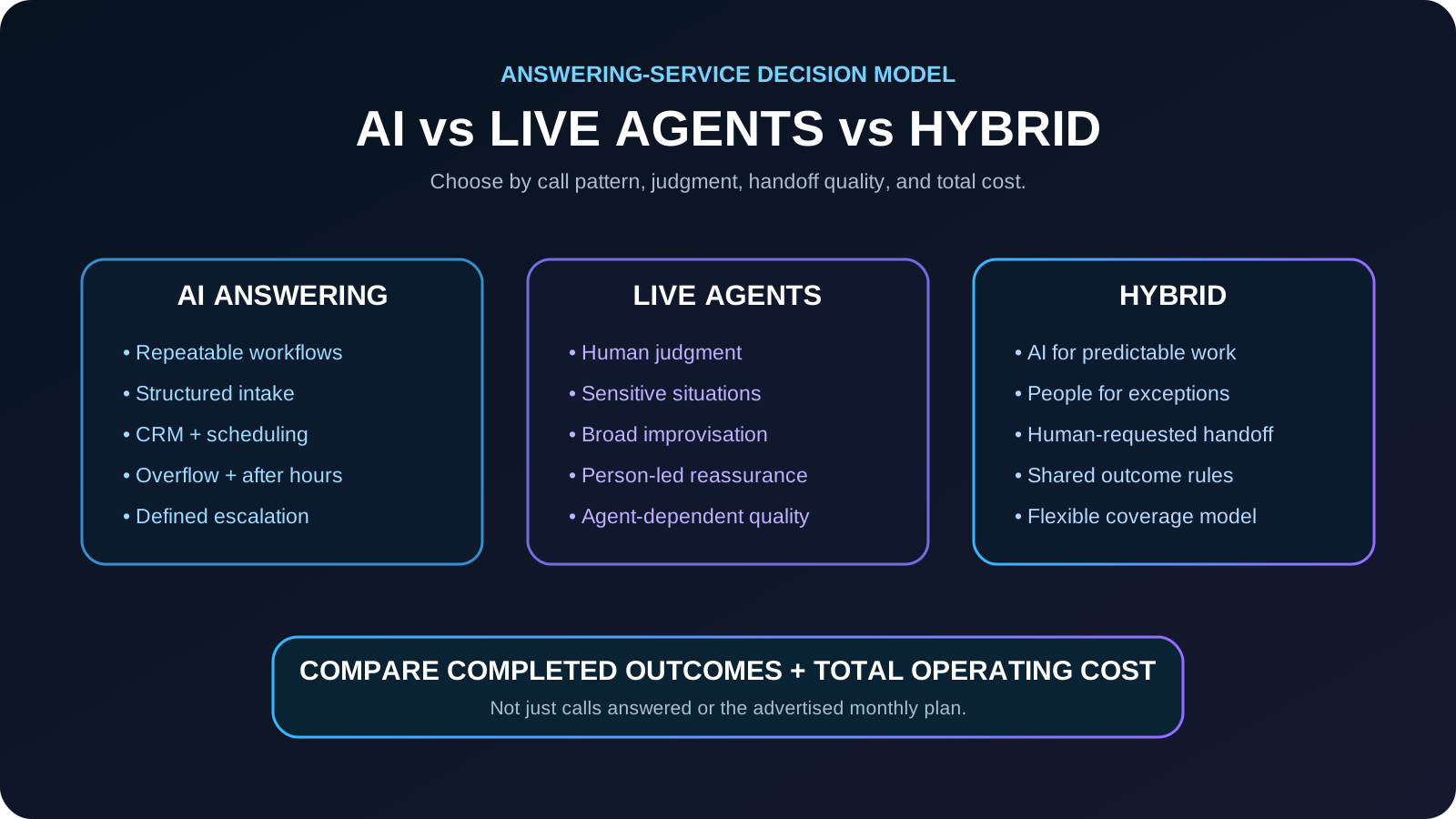
Neither model is universally better. An AI answering service is strongest when calls follow approved, repeatable workflows such as lead capture, business Q&A, scheduling requests, overflow, and after-hours intake. A traditional live-agent service is stronger when conversations regularly depend on broad improvisation, emotional judgment, or sensitive human reassurance. Many small businesses benefit from a hybrid design that uses automation for predictable work and people for exceptions. Compare total cost and completed outcomes, not only the advertised plan price.
What matters most
- Use AI when the call can follow approved rules, required fields, and defined next actions.
- Use people when judgment, empathy, improvisation, or sensitive reassurance dominates the conversation.
- A hybrid model can use AI for predictable coverage and people for exceptions.
- Compare total operating cost rather than headline plan price alone.
- Measure completed outcomes, missing information, transfer accuracy, and staff cleanup.
- Test edge cases and requests for a person before launch.
AI Answering Service vs Traditional Answering Service: Cost, Coverage & Fit (2026)
An AI answering service and a traditional live-agent answering service solve the same basic coverage problem with different operating models. The important comparison is not whether software or people are universally better. It is which model reliably completes the calls your business actually receives.
AI is strongest when the business can define the approved questions, required fields, next actions, transfer rules, and exceptions. A live answering service is strongest when the conversation regularly depends on judgment, improvisation, reassurance, or situations that should remain person-led.
A hybrid can preserve both advantages: automation handles repetitive coverage and structured intake while people handle exceptions, sensitive calls, and the conversations where judgment matters most.
Quick decision guide: AI, traditional answering, or hybrid?
Start with the call pattern instead of the technology. The same business may use more than one model because routine estimate requests and sensitive customer complaints do not require the same type of handling.
- Choose AI for repeatable questions, structured lead capture, scheduling requests, overflow, after-hours intake, CRM delivery, and rule-based routing.
- Choose traditional live agents when most calls are highly variable, emotionally sensitive, relationship-heavy, or difficult to reduce to approved steps.
- Choose hybrid when the business wants fast structured coverage but still needs a person for exceptions, escalations, or callers who request one.
- Keep voicemail plus disciplined callbacks when call volume and urgency are low enough that a more complex system would not add meaningful value.
The best model is the one that completes the required business outcome with the least caller friction and the least cleanup for the team.
Compare the full operating cost, not just the monthly plan
AI and traditional services may price work differently, so headline plan prices are rarely an apples-to-apples comparison. Include the cost of usage, overages, transfers, integrations, implementation, account changes, and the internal staff time required to repair incomplete handoffs.
- Base subscription or service fee
- Included usage and overage rules
- Transfer, message, text, scheduling, or integration charges
- Implementation, workflow setup, and revision costs
- Internal staff cleanup after incomplete or inaccurate calls
- Total cost divided by verified completed outcomes
What a traditional answering service does
A traditional answering service routes your calls to a pool of human agents. Those agents usually follow a script, collect basic information, take messages, transfer urgent calls, and sometimes schedule appointments. The service is valuable when callers expect a human and when conversations regularly require judgment that cannot be reduced to a reliable workflow.
The experience depends on the quality of the agent pool, training, staffing levels, account notes, and the amount of context available to each agent. A strong provider can sound professional and empathetic. A weak or overloaded provider may sound generic, place callers on hold, mispronounce names, or collect incomplete messages.
- Best for conversations with frequent exceptions or emotional nuance
- Can provide human reassurance during sensitive situations
- Often priced by minutes, calls, usage tiers, or overages
- Quality may vary across agents and shifts
What an AI answering service does
An AI answering service answers calls through a voice agent configured around your business. It can greet callers, determine intent, answer approved questions, collect lead details, qualify inquiries, send text follow-up, schedule or request appointments, and escalate calls according to rules.
The primary advantage is consistency. The system does not forget the current offer, skip a required question, or use a different intake process on the night shift. The primary limitation is also consistency: a poorly designed workflow will repeat the same mistake until it is corrected. Good implementation therefore requires careful scripting, guardrails, testing, and a clear path to a person when the call falls outside the expected flow.
- Answers immediately when capacity is available
- Uses the same approved workflow on every call
- Can connect call data to scheduling, CRM, SMS, and reporting
- Requires thoughtful setup, review, and escalation rules
Side-by-side comparison
| Decision factor | Traditional service | AI answering service |
|---|---|---|
| Response consistency | Can vary by agent and shift | Repeatable when the workflow is configured correctly |
| Complex judgment | Usually stronger for unpredictable human situations | Strongest when intents and policies can be defined |
| Scaling call volume | Depends on staffing and provider capacity | Can scale quickly within technical and plan limits |
| Pricing model | Commonly usage-based with tiers or overages | Often subscription, usage, or blended pricing |
| Business-system integration | Varies by provider and plan | Can be designed around CRM, calendar, SMS, and routing |
| Training updates | May require account notes and retraining | Workflow changes can be applied centrally |
| Fallback | Supervisor or on-call staff | Transfer, callback queue, or human escalation |
Which model fits which business?
Choose a traditional answering service when the majority of calls are sensitive, highly variable, or depend on human discretion. Choose an AI answering service when the majority of calls follow recognizable patterns such as quote requests, appointment inquiries, availability questions, order status, basic qualification, or after-hours lead capture.
Many businesses should not treat this as an all-or-nothing decision. A hybrid design can let AI handle the predictable first layer and transfer urgent, complex, or emotionally sensitive calls to a person. That preserves fast response while concentrating human attention where it matters.
A useful pilot does not ask whether the system can hold a conversation. It asks whether the system can complete your five most valuable call outcomes accurately.
How to run a fair comparison
- Export or review a representative sample of recent calls and group them by intent.
- Identify the five outcomes that create the most value, such as booked estimates, transferred emergencies, or complete lead records.
- Write the required questions, prohibited claims, escalation triggers, and after-hours rules.
- Test both normal calls and edge cases, including interruptions, unclear answers, and requests to speak to a person.
- Measure completed outcomes, missing information, caller friction, transfer accuracy, and total monthly cost.
Example: an after-hours service request
A homeowner calls at 9:40 p.m. because the air conditioner stopped working.
The AI follows the business’s approved urgent-service intake, captures the address and equipment problem, and routes the request according to the configured after-hours rule. A traditional service can perform the same workflow through a live agent, with performance depending on staffing, training, queue conditions, and account instructions.
The better model is the one that captures the required facts, applies the correct escalation rule, and gives the caller a truthful next step.
Frequently asked questions
Will callers know they are speaking with AI?
Disclosure expectations depend on your location, industry, and use case. The safest operational approach is to use transparent language and avoid designing the agent to mislead callers about what it is.
Can an AI answering service transfer calls to a person?
Yes, when the phone system and workflow are configured for transfers. A good design defines exactly which intents, hours, and urgency levels trigger a transfer.
Is an AI answering service always cheaper?
Not always. Cost depends on call volume, usage, setup, integrations, monitoring, and the amount of human backup required. Compare total cost against completed business outcomes, not only the advertised monthly fee.
What is the biggest difference between an AI answering service and a traditional answering service?
The main difference is how the work is performed. AI follows configured knowledge, workflows, and escalation rules consistently; a traditional service relies on people who can use broader judgment but may vary by agent, training, shift, and account context.
Can a business use AI and a human answering service together?
Yes. A hybrid workflow can let AI handle routine questions, lead capture, scheduling requests, overflow, and after-hours intake while sending sensitive, unusual, or person-requested calls to a live agent or the business team.
How to verify this answer in your own business
Verify the comparison with the same representative call scenarios, written success criteria, and full operating-cost model rather than assuming either AI or human answering is always superior.
- answer speed
- required-field completion
- correct transfer rate
- booking completion
- caller complaints
- cost per completed outcome
Run normal, busy-period, after-hours, interrupted, ambiguous, sensitive, and person-requested calls through each model. Score required-field completion, correct next action, handoff quality, caller friction, staff cleanup, and total cost per verified completed outcome.
Evidence policy: this page does not invent a universal conversion rate. Results depend on call demand, workflow quality, staff response, and implementation.
See how AEOS connects customer conversations to business actions.
Explore AEOS by Orca Charts for AI receptionist, scheduling, CRM, follow-up, business Q&A, live transfers, and team workflows for Answering Service Alternatives.